


35 Jackets, 3 Favorites: In Search of a Successor to My Shakedry
Note: I mention brands and models here. I have no affiliation with any of these brands. Even so, I'm flagging this as advertising, since brand names are mentioned.
On this blog, I always like to let you in on my thinking and the changes I make. This time, I want to take you along on my search for a new rain jacket.
I own a Gore Shakedry jacket, which I still consider the ultimate when it comes to breathability and waterproofness. I don’t just carry the Shakedry as rain protection, I also wear it when it’s windy, or when I need light protection against cold and damp. So it’s a constant companion.

But it has one drawback: the fabric is extremely delicate. Over our many shared kilometers, I’ve repeatedly torn holes in it. That happens from branches and thorns, abrasion from wearing a hydration pack, or accidental mechanical damage, for example from a frame bag’s zipper or a fall. So I already have a fair number of Gore patches on my jacket. And it has no hood.
My Requirements for the New Jacket
So it’s slowly becoming time to look around for a new jacket. My requirements for it are:
Must-have criteria
- Fully waterproof, even during hours of sustained rain
- As high breathability as possible, similar to the Shakedry
- Light
- Packs down small
- An adjustable hood that can be stowed/rolled away (into the collar)
- More durable than the Shakedry
Important
- PFC-free DWR and PFAS-free membrane
- Ventilation options (pit zips or similar) — a “nice to have,” since with lightweight shells this is usually handled by the membrane anyway
- Hood works with a helmet: ideally fits over the helmet and can be fixed in place (not flapping); alternatively, worn snugly under the helmet over a cycling cap
- Durability / long-lasting DWR coating
Nice-to-have
- Cycling-specific cut or extended back hem
- Abrasion-resistant, since a hydration pack is often in use
So at its core: a light, small-packing, fully waterproof, and highly breathable jacket with a stowable, non-flapping hood, and PFAS-free.
And as always, this is also a search for a unicorn that does it all — but in the end I found three jackets that come especially close to my requirements, each with its own trade-offs, though.
But let’s talk about materials first, because a lot has changed here, and once again I found a spec that isn’t communicated consistently by all manufacturers — and on top of that, can be measured in different ways.
If you just want my recommendation: I ended up finding three jackets that meet all the criteria. You can jump straight to the list of 35 jackets and my favorites.
Everyone else, stick with me for a quick tour of the technology behind it first. This knowledge is worth having, not least to better understand my choices.
The Technology Behind It – What the Numbers Really Mean

Breathability: RET vs. MVTR
This is the figure that mattered most to me in this search. Unfortunately, manufacturers communicate it in two different ways that can’t be compared with each other:
- One is RET (per ISO 11092). This measures resistance to water-vapor transfer. The lower the RET value, the better. This figure is standardized, and therefore comparable across brands and manufacturers. The RET scale runs from < 6 extremely breathable, 6–13 very good, 13–20 good, 20–30 moderate, to > 30 barely breathable.
- And then there’s MVTR, measured in g/m²/24h. This figure indicates how much vapor passes through per area and day. The higher the value, the better. BUT: there are at least four test methods (JIS B1/A1, ASTM upright/inverted) that produce completely different numbers for the same jacket. An MVTR figure without a stated test method is essentially worthless for comparison purposes and can be read as pure marketing. It often just comes down to producing big numbers.
Where it’s available, I try to orient myself by the RET value. And my benchmark, the Gore Shakedry, has a RET value of < 3.
Hydrostatic Head: Why 20,000 mm Doesn’t Always Mean 20,000 mm
At its core, this measures how much water pressure the fabric can withstand before it lets water through.
In the EU, a material is considered “waterproof” starting at around 1,300 mm. That’s pretty divorced from reality, though, because in actual rain and hours of pedaling under such conditions, you need at least 10,000 mm, and really more like 20,000 mm+.
BUT: here too you have to pay close attention, because there are different test methods and therefore different numbers, depending on whether it’s an EU or a US manufacturer/method.
- In Europe, the hydrostatic head is usually measured according to ISO 811 (or the newer ISO 20811): this is a water-pressure test in which the fabric is subjected to steadily increasing pressure until water gets through. The result is given in mm of water column (e.g. 20,000 mm).
- In the US/Canada, the common test is often AATCC 127. It’s methodologically similar, but with different test conditions regarding the rate of pressure increase, test duration, and sample size. As a result, the numbers aren’t directly comparable, even though both are given in “mm.” A jacket rated 20,000 mm under AATCC is therefore not necessarily just as waterproof as a jacket with the same mm rating measured under ISO 811.
On top of that, some US brands (especially cottage manufacturers like Zpacks or Enlightened Equipment) don’t state any standard at all, so you don’t know which method was used to measure it.
So the mm figure is only meaningful within the same test method, for example, to compare two European brands. But you need to be careful comparing across brands or continents. It’s most reliable when a manufacturer explicitly names the test standard. If it’s missing, you should treat the number as a rough guide, not an exact point of comparison.
And you shouldn’t conflate two things: a high hydrostatic head says nothing about breathability. Both figures need to be considered independently.
Membrane Types: ePTFE, ePE, PU & Co.

The membrane is the decisive factor, because it’s what makes a jacket waterproof and breathable. It’s the heart of every jacket: a wafer-thin functional layer laminated between the outer fabric and the inner lining.
A good membrane has pores or a structure that’s too small for a water droplet but large enough for a vapor molecule. That way, rain stays outside while sweat vapor can escape. How well this works in detail varies a lot depending on the membrane type.
For this article, it’s useful to know the following membranes:
ePTFE – the classic, but with a sustainability problem
ePTFE is the material that made Gore-Tex famous starting in the 1970s, and it’s still found today in many “classic” Gore-Tex jackets. However, PTFE is a so-called fluoropolymer and counts among the “forever chemicals” that barely break down in the environment. On top of that, the accompanying DWR coating was traditionally treated with especially long-lasting but environmentally harmful PFCs/PFAS.
Because of increasing EU regulation – and hopefully also out of environmental and sustainability awareness – manufacturers are actively phasing this material out right now. There are still jackets with this membrane out there, though I’d avoid them.
ePE – the PFAS-free successor
ePE (expanded polyethylene) is Gore’s answer to the PFAS problem: a new generation of membrane that works entirely without intentionally added fluorochemistry. It’s currently replacing the classic ePTFE membrane step by step across Gore’s product lines. In terms of waterproofing and breathability, it’s on par with good classic Gore-Tex. However, this membrane is still relatively new to the market. There’s less long-term experience regarding its durability than with the decades-old ePTFE.
Gore-Tex’s Sub-lines at a Glance
Since “Gore-Tex” alone says nothing about actual performance, it’s worth taking a look at the sub-lines that frequently show up in reviews and product descriptions:
- Paclite/Paclite Plus: this is Gore’s lightweight line, with low weight and a small packed size. However, breathability is only middling.
- Active: this is the most breathable standard line, designed for high-exertion sports. It’s often very thin, though, and less rugged.
- Pro: this is the toughest, most durable line, built for extreme alpine conditions. I always used to wear jackets like this on bike tours in the past. They’re heavy and expensive, but offer maximum durability in return.
- ePE: this is the new, PFAS-free membrane generation (see above), which is now replacing the old ePTFE base across several of these lines.
PU-based Membranes – the Large, Inconsistent Majority
Most brands without a Gore-Tex license use their own, mostly polyurethane-based membranes (PU): Pertex Shield (Rab, Montane, Albion), Toray Dermizax (Saysky), Dynafit Dynashell, Rab Proflex, Montbell SUPER DRY-TEC, and many more.
Technically, they work differently from ePTFE: instead of porous holes, they mostly use a solid but hydrophilic layer, through which water-vapor molecules chemically “diffuse.” That sounds complicated, but put simply, it just means a process instead of a hole.
That does have an upside: the base material of many PU membranes contains no fluoropolymer, unlike ePTFE. Whether the finished jacket — including membrane, laminate, and DWR coating — is actually PFAS-free still needs to be checked separately for each product, though.
BUT: there’s no unified standard the way there is with Gore-Tex. Every brand does its own thing, and quality varies accordingly. That, for instance, also leads to differing breathability figures. For us as customers, all of this is hard to see through and hard to understand when making a purchase decision.
Air-permeable Membranes – the Special Class for Maximum Breathability
A small but important special category are membranes that actually let air through (not just vapor). This delivers the highest breathability technically possible. Examples: eVent, Pertex Shield Air, and the now-discontinued Gore-Tex Shakedry. Shakedry went a step further than the others: it had no textile outer face at all, and the membrane sat directly exposed on the surface, letting water vapor escape almost unimpeded. But that also made the jacket extremely delicate.
Chemistry & Sustainability: DWR, PFC, PFAS
If we’re talking about rain jackets, we also need to talk about chemistry — and therefore about sustainability. So you should know these terms:
DWR (Durable Water Repellent): this is the coating on the outer fabric that makes water bead off. It wears off over time and needs to be refreshed periodically — you may already know this from washing or spraying a jacket with a reproofing treatment. Some manufacturers even state this, noting for example that the jacket’s coating lasts for 50 wash cycles.
PFC/PFAS-free: this already came up above. But it actually refers to two things that should be kept clearly separate: “PFC-free DWR” means the coating is fluorine-free. That is NOT the same as “PFAS-free membrane,” which refers to the membrane itself. A jacket can have one without the other.
bluesign/Öko-Tex: these are certifications for low-pollutant, resource-conserving production. They say nothing about breathability or waterproofness.
35 Jackets in the Shortlist

Waterproof, breathable, rugged, light, and affordable — you never get all five at once. Every jacket is a trade-off on this pentagon, and which corner you sacrifice depends on what you’ll use it for.
Based on my criteria, I researched 35 jackets, which now make up my shortlist. The starting point was a considerably longer list spanning all the relevant brands for bikepacking rain jackets, with well over 50 models. From that longlist, I consistently filtered by two criteria that are non-negotiable for me when it comes to bikepacking:
- First, breathability. You sweat a lot while bikepacking, and you need a jacket that reliably lets the vapor out. So I immediately excluded jackets with low or entirely undocumented breathability: Salomon, Gonso, Fox, Craft, and On Running didn’t make the final list for this reason.
- Second, weight. I thought for a long time about where to draw the line and settled on 350g. Anything above that is, for me, too heavy as a permanent fixture in my luggage — even if some of these jackets otherwise have good qualities. That’s why candidates like the Arc’teryx Beta, the Endura MT500, the Patagonia Torrentshell, or the heaviest Montane got cut.
That left 35 jackets, which I’ve split into three categories: 8 Cycling-First, 16 Trail Running, and 11 Outdoor. The categories are self-explanatory.
Every one of them has at least “medium” breathability and weighs no more than 350 grams. Among them are also some deliberate compromises that I kept in anyway, like the OMM, the Albion Zoa, and the Dynafit Alpine, as well as a few import models that may be harder to order from within Europe.
So what follows isn’t a complete market overview, but an already-filtered selection, sorted for my bikepacking purposes:
| Category | Brand | Model | Price (€) | Weight (g) | Waterproofing (mm) | Breathability (g/m²/24h) | Breathability (Rating) | Material Type | Packed Size | Extended Back Hem | PFC-free DWR | PFAS-free Membrane | Hood Adjustable | Hood Stows in Collar | Hood Helmet-Compatible | Pockets |
|---|---|---|---|---|---|---|---|---|---|---|---|---|---|---|---|---|
| Cycling-First | 7mesh | Guardian Air Jacket | 450 | 200 | 28.000+ | n/a | High | 3L Gore-Tex ePE (15D Ripstop) | Very small | Yes | Yes | Yes | Yes | Yes | Yes | StashSystem pocket (jacket stows inside) + bike clip |
| Cycling-First | 7mesh | Guardian Apex Jacket | 550 | 310 | 28.000+ | n/a | High | 3L Gore-Tex ePE (40D Ripstop) | Small | Yes | Yes | Yes | Yes | n/a | Yes | Hand + chest (zippered) |
| Cycling-First | 7mesh | Revelation Jacket | 550 | 320 | 28.000+ | ~25.000 | Medium | 3L Gore-Tex Pro Nylon | Small | Yes | Yes | No | Yes | Yes | Yes | Chest + hand (zippered) |
| Cycling-First | Albion | Zoa Rain Shell (Unisex) | 480 | 321 | n/a | n/a | Medium | Pertex Shield Pro 3L (Test: Shield Air) | Small | n/a | Yes | n/a | Yes | n/a | Yes | 2 hand pockets (mesh ventilation) |
| Cycling-First | Dynafit | Ride 3L Jacket | 280 | 246 | 20,000 | 20,000 | High | Dynashell 3L Nylon Ultralight | Small | Yes | Yes | Yes | Yes | No | Yes | 2 front ventilation zips |
| Cycling-First | Patagonia | Dirt Roamer Storm Bike Jacket | 340 | 343 | 20,000 | n/a | Medium | 3L H2No Nylon (recycled) | Small | Yes | Yes | Yes | Yes | Yes | Yes | Back pocket + 2 side zips (ventilation/access) |
| Cycling-First | Pedaled | Odyssey Jacket | 290 | 260 | ~28.000 | ~24.000 | Medium | 2.5L Nylon | Small | Yes | Yes | n/a | Yes | n/a | Yes | Chest + hand (zippered) |
| Cycling-First | Vaude | Moab Rain Jacket | 190 | 335 | 10,000 | n/a | Medium | Ceplex Active 2.5L | Medium | Yes | Yes | Yes | Yes | n/a | Yes | Hand (zippered) |
| Trail Running | Alpkit | Gravitas | 230 | 200 | 20,000 | 20,000 | Medium | 3L PU Membrane (10D Nylon) | Very small | No | Yes | Yes | Yes | Yes | No | 1 concealed chest pocket |
| Trail Running | Arc’teryx | Norvan Jacket | 450 | 215 | ~28.000 | ~40.000 | High | 3L Gore-Tex ePE | Very small | No | Yes | Yes | Yes | Yes | No | Hand (zippered) |
| Trail Running | Dynafit | Alpine 3L Jacket | 250 | 200 | 20,000 | n/a | Medium | Dynashell Alpine Eco Light 3L | Very small | Yes | Yes | Yes | No | No | No | n/a (chest vent) |
| Trail Running | Dynafit | Ultra 3L Jacket | 300 | 183 | 20,000 | 30,000 | High | Dynashell 3L Eco | Ultra small | Yes | Yes | Yes | No | No | No | Minimal |
| Trail Running | Haglöfs | L.I.M GTX II Jacket | 300 | 270 | ~28.000 | RET 6 | High | Gore-Tex Paclite Plus 2.5L | Ultra small | No | Yes | n/a | Yes | n/a | n/a | Minimal |
| Trail Running | Janji | Rainrunner Pack Jacket 2.0 | 230 | 229 | 20,000 | 20,000 | Medium | 2.5L | Small | Yes | Yes | n/a | Yes | No | n/a | 1 (doubles as stuff sack) |
| Trail Running | Kathmandu | Seeker 2.5L Rain Jacket | 160 | 200 | 10,000 | 30,000 | Medium | 2.5L recycled nylon (tire waste) | Ultra small | n/a | Yes | n/a | Yes | Yes | n/a | 1 chest pocket (stuff pocket) + strategic venting |
| Trail Running | Montane | Minimus Jacket (formerly 777) | 220 | 160 | ~20.000 | ~30.000 | Medium | Pertex Shield 2.5L | Ultra small | No | Yes | n/a | Yes | n/a | n/a | Minimal |
| Trail Running | OMM | Aether Jacket | 450 | 225 | 20,000 | 20,000 | Medium | Dyneema/Nylon 3L (65gsm) | Small | No | Yes | Yes | Yes | n/a | n/a | 2× hand (zippered) |
| Trail Running | OMM | Kamleika Jacket | 270 | 265 | 20,000 | 20,000 | Medium | Nylon/Spandex 4-way stretch | Small | No | Yes | Yes | Yes | n/a | n/a | 2× hand (zippered) |
| Trail Running | Patagonia | Storm Racer Jacket | 300 | 204 | ≥10.000 | n/a | Medium | 3L H2No recycled nylon | Ultra small | No | Yes | Yes | Yes | n/a | n/a | Minimal |
| Trail Running | Rab | Downpour Trail Light Waterproof Jacket | 160 | 187 | 20,000 | 20,000 | Medium | 2.5L | Small | No | Yes | n/a | Yes | n/a | No | n/a |
| Trail Running | Rab | Phantom Waterproof Jacket | 200 | 117 | 20,000 | 20,000 | Medium | 2.5L | Small | No | Yes | Yes | No | No | No | 1 (hood doubles as stuff sack) |
| Trail Running | Saysky | Element 3L Waterproof Jacket | 320 | 280 | 20,000 | 20,000 | High | Toray Dermizax EV 3L | Small | No | n/a | n/a | Yes | No | No | n/a |
| Trail Running | Saysky | Flow 2.5L Waterproof Jacket | 279 | 110 | 20,000 | 20,000 | Medium | 2.5L | Small | No | Yes | n/a | Yes | Yes | No | n/a |
| Trail Running | Wise | BlackShell³ | 370 | 170 | 20,000 | RET <4.5 | Very high | EvenSafe 3L (Rainshell 253) | Small | n/a | n/a | n/a | Yes | Yes | n/a | 1 (PackablePocket™) |
| Outdoor | Enlightened Equipment | Visp Rain Jacket | 230 | 158 | 10.000–28.000 | 83,000 | Very high | 3L ripstop nylon (7D) + PU | Ultra small | Yes | n/a | Yes | Yes | No | No | None (pit zips only) |
| Outdoor | Haglöfs | L.I.M Proof Jacket | 200 | 205 | 20,000 | 20,000 | Medium | PROOF 2.5L (20D ripstop PA, PU) | Very small | n/a | Yes | Yes | Yes | No | No | 2 hand pockets (zip) |
| Outdoor | Kathmandu | Trailhead Stretch 2.5L Jacket | 160 | 289 | 15,000 | 15,000 | Medium | 2.5L recycled polyester | Small | No | n/a | n/a | Yes | n/a | n/a | 2 hand pockets + 2 inner pockets + pit zips |
| Outdoor | Millet | Fitz Roy 2.5L II Jacket | 155 | 340 | 10,000 | 10,000 | Medium | Dryedge 2.5L Ripstop | Very small | No | n/a | n/a | Yes | n/a | n/a | 2 waterproof hand pockets, pit zips |
| Outdoor | Montane | Phase Lite Waterproof Jacket | 390 | 350 | ~28.000 | RET <13 | High | Gore-Tex ePE | Small | n/a | Yes | Yes | Yes | n/a | n/a | 2 (hand pockets) |
| Outdoor | Montbell | Versalite Jacket | 260 | 166 | 20,000 | 43,000 | High | 3L | Very small | No | n/a | n/a | Yes | n/a | No | 2 (1 chest, 1 interior) |
| Outdoor | Norrøna | Falketind GTX Paclite Jacket | 450 | 258 | ~28.000 | RET 6 | High | 2.5L Gore-Tex Paclite Plus | Very small | Yes | Yes | No | Yes | n/a | Yes | 1 chest pocket |
| Outdoor | Outdoor Research | Helium UL Jacket | 200 | 162 | 20,000 | n/a | High | Toray Dermizax 3D 2.75L (15D) | Ultra small | No | No | No | Yes | n/a | Yes | Chest pocket (stuff sack) |
| Outdoor | Rab | Kinetic 2.0 Jacket (formerly Kinetic Plus) | 230 | 336 | 10,000 | ~35.000 | High | Proflex 3L (Rab) | Small | No | Yes | n/a | Yes | n/a | n/a | Hand (zippered) |
| Outdoor | Salewa | Puez 2.5L Powertex Jacket | 140 | 310 | 10,000 | 10,000 | Medium | Powertex 2.5L Ripstop (50D, 57% recycled) | Very small | No | Yes | Yes | Yes | n/a | n/a | 2 front pockets (waterproof zip) |
| Outdoor | Zpacks | Vertice Rain Jacket | 270 | 168 | 20,000 | 56,000 | High | 3L ripstop nylon (7D) | Ultra small | n/a | Yes | n/a | Yes | No | n/a | 1 large chest pocket |
>>> You can also download the current Excel list here.
Note: if you know of other jackets that fit my selection criteria, feel free to write to me or comment here. And if you spot any incorrect information, please let me know too, so I can fix it. I’ve personally checked this list multiple times, but it’s always possible to overlook something.
What I find really remarkable is that brands like Albion, Dynafit, or Pedaled don’t really give complete information about their materials’ performance. There are proprietary categories, or no information at all. I don’t think that’s good. So I had the breathability “estimated” based on the stated materials and then classified accordingly into Very High/High/Medium. That was my way of sorting things to get some overview — but it’s not measurement-grade, since concrete information was often unavailable.
And to make it easier to get an overview, I had AI plot the jackets graphically across the five categories “Waterproof, breathable, rugged, light, and price.”
The Rain Jacket Pentagon

Here are some individual overviews, sorted by breathability, weight, and price:


My Three Favorites
I’ve now spent days poring over these jackets, weighing pros and cons, researching again, finding new information, and rethinking everything all over again. In the end, I found 3 top candidates for myself:
Wise BlackShell³

Wise comes from France and is best known in trail running circles. With the BlackShell³, they offer a jacket that, at 170g, is not only especially light but, with a RET value of < 4.5, also highly breathable. That gives it the best figure in this entire jacket selection, putting it within reach of the Shakedry’s performance. Waterproofing is rated at 20,000mm, which is more than sufficient.
The material is 3-layer and is called Rainshell 253 by Wise. The zipper opens in both directions, and the DWR coating is rated for more than 50 wash cycles. The hood can be adjusted and stowed away when not in use, but it isn’t listed as helmet-compatible. The price is €370 — which is fine for a small manufacturer like Wise.
Dynafit Ultra 3L

Dynafit comes from Bolzano/South Tyrol and, like Wise, is a brand at home in trail running as well as ski and mountain touring. The Ultra 3L weighs just 183g, is made from 3-layer Dynashell, and offers high breathability at 30,000 g/m²/24h. This jacket is also waterproof to 20,000mm.
What I particularly like is the so-called ZipOver back: it has a zipper that, when needed, opens up more room so you can wear a pack underneath the jacket. Naturally, this jacket also has a hood, though it isn’t helmet-compatible. When not in use, the jacket packs away into the hood. The price is 300 euros, though it’s currently out of stock as well.
7mesh Guardian Air
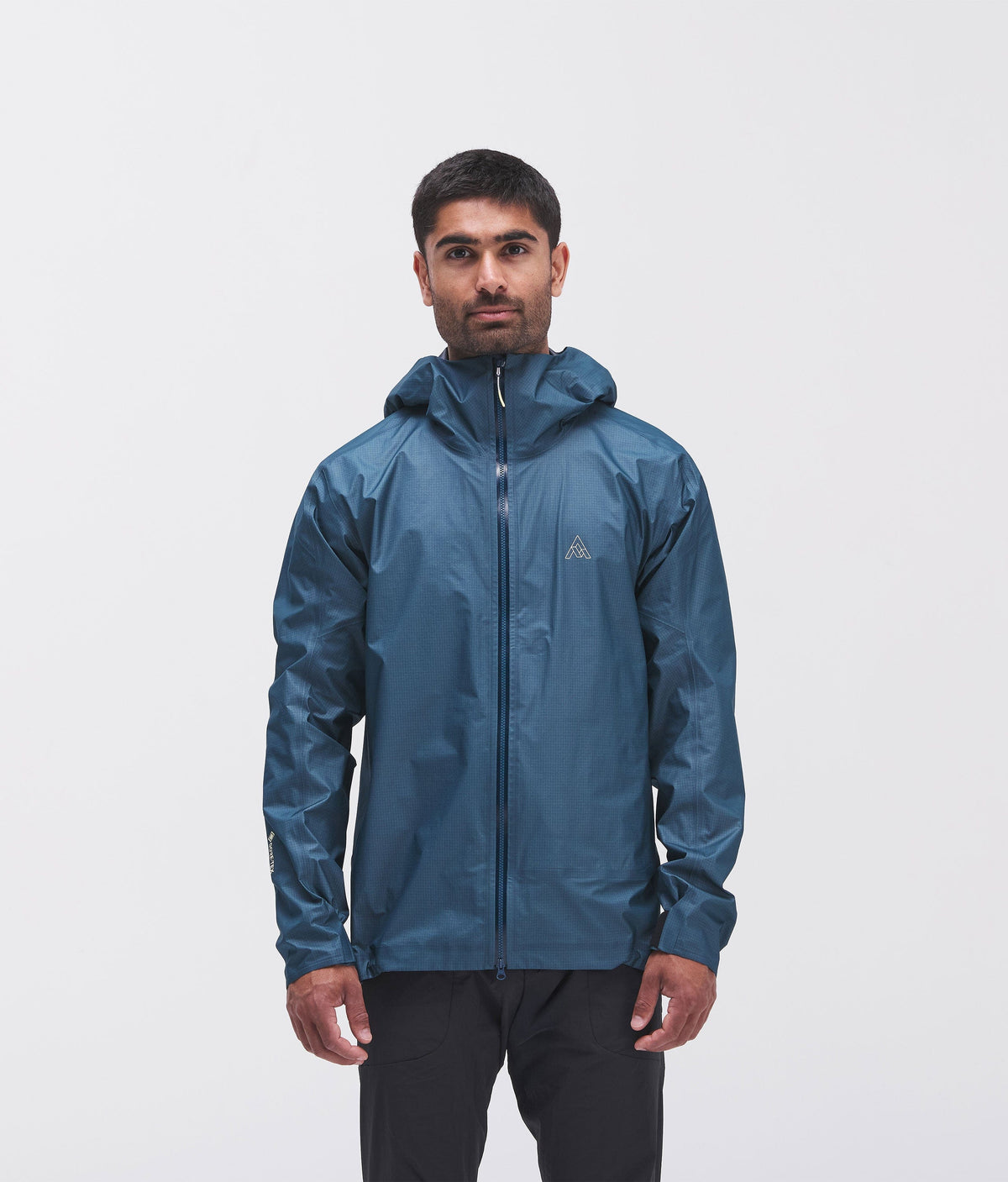
7mesh comes from Canada and offers, with the Guardian Air, a jacket that weighs just 200g. It combines a GORE-TEX ePE membrane with an ultralight 15-denier ripstop nylon outer fabric and a C-Knit backer made from recycled material. Waterproofing is rated at a minimum of 28,000mm.
The composition of the membrane materials suggests high breathability. However, 7mesh doesn’t publish a directly comparable RET or MVTR value.
The Guardian Air has interior pockets, which is quite practical. The CrossPull hood is also helmet-compatible and stows away neatly when not in use. On top of that, the 7mesh features the StashSystem, meaning the jacket can be packed into a side pouch and conveniently attached to a bike or belt. At around 450 euros, the price is on the higher end.
My (Preliminary) Conclusion
This isn’t a 100% decision yet. Right now, I’m leaning toward the 7mesh Guardian Air, mainly because of the hood: the CrossPull system sits firmly over the helmet without flapping, and rolls away into the collar when not in use. That solves the problem that always bothered me with my old Mountain Equipment Skardu, where the hood just flaps around and can’t be stowed. On top of that, the membrane is PFAS-free, and at 200g it still comfortably stays under my weight limit.

But I’m not fully convinced yet, because there are trade-offs here too: with its ultralight 15-denier ripstop, the Guardian Air is optimized for low weight, and how well the thin fabric holds up over time against branches, falls, and especially abrasion from a hydration pack would have to be shown in practice. At around 450 euros, it’s also the most expensive of my three favorites.
The Wise BlackShell³ and the Dynafit Ultra 3L are lighter and cheaper, and also provide more concrete breathability figures, whereas 7mesh doesn’t publish a directly comparable RET or MVTR value for the Guardian Air.
So here’s my question/request to you: have any of you already used one of these three jackets? Whether on bikepacking trips, in sustained rain, or with a hydration pack? How does it perform in practice — what about breathability, durability, and the hood?
Feel free to write to me in the comments. Your experiences will definitely factor into my decision.


